Posts

Showing posts with the label Mutant

Mutant Series: SOSEKI

Image
Like a sailor uses a compass to find the direction to navigate the ship, how does a cell navigate itself without a compass? or do they have their own compass? Let me break the question into a simpler version. Cells need to know where they will make their next cell or in which direction? Cell does their stuffs through proteins. Is it possible that cell uses some proteins to act as compass? If so, what should be function of those proteins? Similar to compass, they will direct the cell to a certain direction, exactly as compass. We can imagine, rather than roaming here and there inside the cell, those proteins will localize into a certain part of the cell. You are right - they will hang out in one corner of the cell to show the direction, in general term.  I am a plant biologist, assuming that most of the readers already know that. I love to think about the direction of the cell, more precisely plant cell. There are already a substantial amount of plant proteins we already know, who

Mutant Series: PIZZA

Image
Sometimes I feel totally guilty of not writing new stuff when several hundred readers are visiting the blog every single day! I've moved from one country to another, then from one state to another. It went like that, Japan (March) → Michigan, USA (June)  → Massachusetts, USA (present). I'm going to start with a less serious, more funny and humorous one – Mutant Series! Thanks for your support and I appreciate your time and feedback to bring this blog so far.   If you smell food, do you? from the title of the post – I'm not responsible for that as usual. It all started with the Keiko Sugimoto's work on plant hormone, Brassinosteroids (BR). In a standard genetic approach, we usually use loss-of-function mutant to find out the function of that gene ( reverse genetics approach ) or randomly mutated genes and then find out which is our target gene for certain criteria ( forward genetics approach ). But, for BR metabolism, it's not obvious to see the growth phenot

Mutant Series: THESEUS (THE)

Image
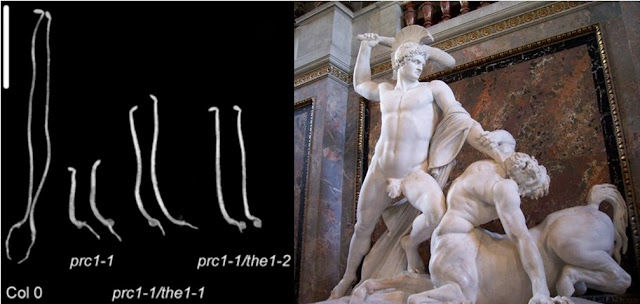
Plants have one unique component as a boundary, known as "cell wall". Alteration of the cell wall or its components demonstrates visible phenotype at the whole plant level. One of the major components of the cell wall is cellulose.   Cellulose-deficient mutant, such as procuste 1-1 ( prc1-1 ), has short hypocotyl containing phenotype. prc1-1 has the defect in cellulose synthase catalytic subunit CESA6. But, it was not known how the short hypocotyl containing phenotype was developmentally coordinated. To understand that when chemical mutagenesis was introduced in the prc1-1 mutant background, 5 intermediate length hypocotyls (hypocotyl was between the wild-type and prc1-1 ) containing plants were picked up. Among these 5, the same gene was mutated into 2 cases. They named that gene THESEUS (THE). Theseus was the Greek mythical founder-hero of Athens and he slaughtered the rogue smith and bandit Procrustes. Here, in Arabidopsis, the short hypocotyl of pcr1-1 is also re

Mutant Series: IRON MAN (IMA)

Image
-  Guess, how many people are suffering from I ron- d eficiency induced a nemia (IDA)? -  It's more than one billion worldwide!   The number is incredibly big. It was even difficult for me to believe at the first time. The main cause of the disease is iron (Fe) deficiency. Fe is by mass the most common element on earth. Plants uptake Fe and as a consumer, we obtain Fe from the edible parts of plants. Unfortunately, free forms of Fe is taken up by plants and some parts of the soil which is rare. This is how such an abundant element becomes unavailable. Simply, finding the plant capable of uptaking more Fe or efficient of Fe uptake from the Fe-deficient soil will help to provide good enough amount of Fe in our food and get rid of IDA.  The image is collected from wanelo.com Recently in a preprint, there is a report about a short 19 C-terminal amino acid sequence consensus motif which is indispensable for Fe uptake in plants. They named it IRON MAN (IMA) . It's base

Mutant Series: SHY GIRL (SyGl)

Image
It's been few months, I haven't share any whimsical or funny gene or mutant. Partly, I was extremely busy with manuscript writing (academic excuse!) and another way, just holding myself to start with a very exciting story out of my comfort zone. Recently, I read an amazing article and definitely involves a funny and logical name too. Here it goes.  During the evolution of land plants, we mostly observe flowering plant capable of producing fruits. These flowering plants are known as "angiosperm in plant biology term. Among flowering plants, we sometimes see that male and female organ stay at the same time, called "hermaphroditism". But, there is another type, which has a more similar sexual system as human. In that case, an individual plant has either male or female identity like the human. This is known as "dioecious". In the evolutionary time scale,  dioecious plants appear later.   In case of human, we already know that Y chromosome contains

Mutant Series: WEREWOLF (WER)

Image
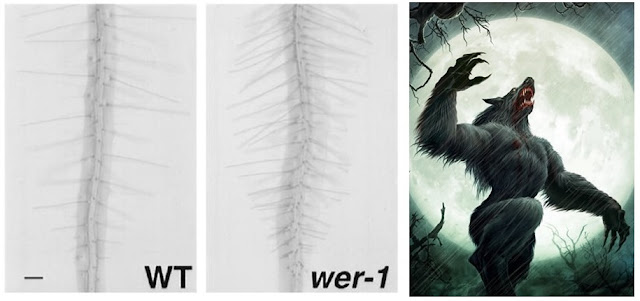
In the last post , we talked about a mutant which is unable to form root hair. In contrast, we will go through a mutant which produces too many root hairs.  Myeong Min  Lee and  John  Schiefelbein from the University of Michigan were screening EMS-mutagenized seedlings for abnormal root hair phenotype. They picked up three mutants produce too many root hairs (hairy phenotype) and eventually figured out that these three mutants represent one gene. Due to its "hairy" phenotype, they named it WEREWOLF (WER)!   In the above picture, we can easily compare the hairy phenotype between  wer-1 and wild-type. This name is based on the movie WEREWOLF, where it has a hairy appearance too.  In general, root hair formation is the ideal example of epidermal patterning. In the epidermis, root hair and non-root hair cells are organized one after another. Less or more number of root hair formation represent the aberration of epidermal patterning.  In case of wer-1 ,

Mutant Series: KOJAK (KJK)

Image
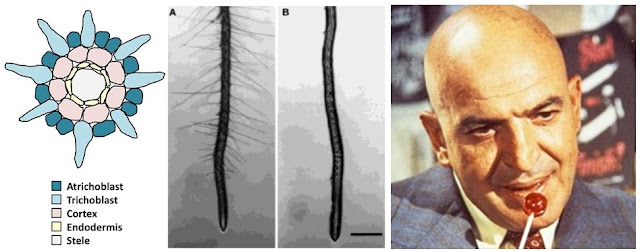
Plant development consists of cell division, cell elongation, and differentiation. In the root of model plant Arabidopsis thaliana , we can follow all these three events easily. Cell starts to divide at the meristem, moves out from the meristematic region and then starts to elongate. After entering the maturation zone, it forms root hair and lateral root. Root hair comes first. The place from where we see the root hair, we consider it as maturation zone. Root hairs help to uptake water and ion, anchor and interact with symbiotic microorganisms. If we look at the cross-section of root, the outer most layer is known as the epidermis. This layer has two types of cells: atrichoblast (non-root hair cell) and trichoblast (root hair cell). Only trichoblast produces root hairs. The formation of root hair follows few steps. Firstly, it creates a polar growth zone, popularly knows as "bulge". This "bulge" forms due to the thinning of the cell wall. In the next step, the

Mutant Series: TOO MANY MOUTHS (TMM)

Image
If you don't have clear idea about stoma and pavement cell, I'll request you to go through the following link first.  Mutant Series: SCREAM (SCRM)   Back in 90's, the knowledge about stomatal development and regulation was limited. In the forward genetic approach, we can mutated genes all over the genome in a random fashion. This job is mostly done by E thyl M ethane S ulfonate (EMS). From that randomly mutated population, we screen for our desired traits or phenotypes. In case of stomatal development, if we can find phenotypes containing less or more stoma or abberant pattern.  Ming Yang and Fred D. Sack from Ohio State University took the forward genetic approach to understand the stomatal development. They have found two interetsting mutants: tmm and flp . tmm and flp represent  t oo m any m ouths and f our l i p s , respectively. In case of wild-type plants, we rarely observe two adjacent stomata cells (left panel). In contrast, tmm shows cluster of s

Mutant Series: SCREAM (SCRM)

Image
Plants produce its own food through the process of photosynthesis, a combination fo water, carbon dioxide with the help of sunlight to produce sugar for itself and release oxygen for us. The entrance of gaseous components (carbon dioxide) is mediated through specialized cell known as the stoma. These specialized cells have the capacity to open and close themselves. In contrast, cells don't have such capacity is called pavement cells.  A cell's fate to become either pavement cell or stoma depends on an intricate circuit of three proteins (SPEECHLESS-MUTE-FAMA). This circuit ensures stomatal differentiation or on the other hand, proliferative cell division results into pavement cells. Keiko Torii and her team did the amazing job so far to understand this molecular process.  Pavement cells and stoma seats side by side and make a nice patterning. Between two stomata cells, there is always at least one pavement cell as spacing. Keiko Torii and her team identified

Mutant Series: OPEN ALL NIGHT LONG (OPAL)

Image
OPEN ALL NIGHT LONG. It sounds like a coffee shop or bar or club or karaoke, something like that. Interesting enough, it's a name of one Arabidopsis thaliana mutant.  Plants have an economic life as like as most other biological systems. It makes its own food using water, sunlight, and carbon dioxide. The process knows as photosynthesis. At the day time, it opens its gate/stomata. In the daytime, light is available and perfect time for cooking/photosynthesis for them. In the night, they just close the door/stomata to prevent water loss through transpiration. So, for plants, the following things happen generally in the case of stomata opening and closure.  Nighttime stomatal control is important from both evolutionary and ecological perspective.  But, the mechanism is not clear whether this dark response is simply a passive consequence of the absence of light stimulus, or an active process recruiting other mechanisms of stomatal closure or involving independent signal

Mutant Series: COBRA (COB)

Image
In 1993, Philip Benfey published a paper in Development about four mutants which have aberrant post-embryonic root development phenotypes. Among those four root morphogenesis mutants of Arabidopsis thaliana , one is known as COBRA. Certainly, it gives us a feeling of imagining a snake. The question pops up in our mind, what's the story behind this naming? Is it based on phenotype or just a wish during naming?   In this mutant, the root expands in an unusual manner.  More precisely, it appeared that the epidermal layer had the greatest expansion.  In cob , the epidermal cells were approximately 15 times larger in area than wild-type cells. The cortex and stele were expanded by 2.5 and 3.9 times respectively in this mutant. Interestingly, t he aerial parts of  cob  were very similar to wild-type [1]. This is how the morphogenic study during genetic screening helped to find a mutant specific for root development. In the following figure, we can see the similarities between mutan

Mutant Series: HAWAIIAN SKIRT (HWS)

Image
The most beautiful thing about the plant is a flower. Arabidopsis thaliana has a very small characteristic flower which eventually turns into silique to produce seeds, unfortunately, no fruits! Like any other flowers, it contains petals, sepals, carpels, stamens. During the maturation of silique, it gets rid of sepals and petals.  A recent study from Detlef Weigel team has found one mutant defective in proper silique formation from flowers. They identified the new mutant allele which is an F-box protein and works as a suppressor of the MIM156 (miRNA target mimic 156)-induced developmental and molecular phenotypes. In this mutant plants, levels of endogenous miRNAs are increased and their mRNA targets decreased. Plants constitutively expressing the particular full-length protein simulate miRNA biogenesis mutant phenotype. In combination with such mutants, it loses its delayed floral organ abscission phenotype.   This mutant has a very funny name. HAWAIIAN SKIRT (HWS). B

Mutant series: Argonaute 1 (AGO1)

Image
ARGONAUTE (AGO) protein family was named first as PAZ proteins. "PAZ" represents p ELEMENT-INDUCED WIMPY TESTS ( P IWI) from  Drosophila , ARGONAUTE1  ( A GO1) and  ZWILLE (ZIL) from  Arabidopsis thaliana . All these proteins were discovered initially, and they shared a common domain.    Later, it has been found that DICER proteins also contain PAZ domain. To distinguish them from DICER proteins, then it was renamed as PPD ( P AZ P IWI D OMAINS) proteins. Because of this renaming, it clearly distinguished between ARGONAUTE and DICER based on the presence of domains. For ARGONAUTE, PIWI domain is unique.    From the functional analysis, it had been shown that few PPD proteins has RNaseH-like activity, cleaves targeted ssRNA (single-stranded RNA). To make an adjustment with the DICER for naming, they named as SLICER. It's a cool name, isn't it? Eric Lander called it "enzymatic king-fu"!  However, problems remained. Not every member of this PPD pr

Mutant series: LORD OF THE RINGS 1 (LOTR1)

Image
I'm a huge fan of Niko Geldner and Casparian strip story. A new paper came up recently in Current Biology which is like another bead of that string.  Rather than describing the whole story, this post will focus only about the newly identified gene reported in this paper. In a broader sense, "Mutant series" is going to be lot more fun to know about the story behind the naming of mutants and science as well as.  Figure 1: Graphical abstract of the paper Nutrients pass through two ways - apoplastic and symplastic pathway - to enter the root system. Formation of Casparian strips and suberin lamellae limits the free diffusion of nutrients and harmful substances.  In root, endodermis cells have Casparian strips and kind of act as a belt around the vascular tissues to control nutrient entry.  Casparian strips are ring-like lignin polymers deposited in the middle of anticlinal cell walls between endodermal cells and fill the gap between them. Suberin lamellae are gl